
Ayurvedic Approach to Vata, Pitta & Kapha: Discover Your Unique Constitution

Introduction to Ayurvedic Approach to Vata Pitta & Kapha
Have you ever wondered why people respond differently to the same food, weather, exercise routine or stressful situation? Ayurveda, India’s traditional system of health and wellbeing, explains these individual differences through the concept of Prakriti, or individual constitution. According to Ayurvedic principles, the body is understood through the five great elements—earth, water, fire, air and space—and their functional expression through three doshas: Vata, Pitta and Kapha. The relative proportions of these doshas are traditionally considered to contribute to an individual’s constitution. CCRAS – Ayur Prakriti Web Portal Manual
The Ayurvedic approach is therefore highly individualised. Instead of assuming that the same food, routine or lifestyle is appropriate for everyone, Ayurveda traditionally considers constitution, age, environment, season, digestion, lifestyle and the person’s current state. Contemporary research has examined Prakriti as a constitutional framework, although scientific researchers continue to evaluate and improve the reliability and validity of Prakriti assessment tools. Prakriti Assessment – Critical Review (PMC)
Ayurvedic body types should be understood as a traditional wellness framework, not as a replacement for modern medical diagnosis. When using Ayurvedic medicines or herbal products, safety, quality, appropriate practitioner guidance and product standards are important considerations. WHO – Benchmarks for the Practice of Ayurveda
What Are Vata, Pitta and Kapha?
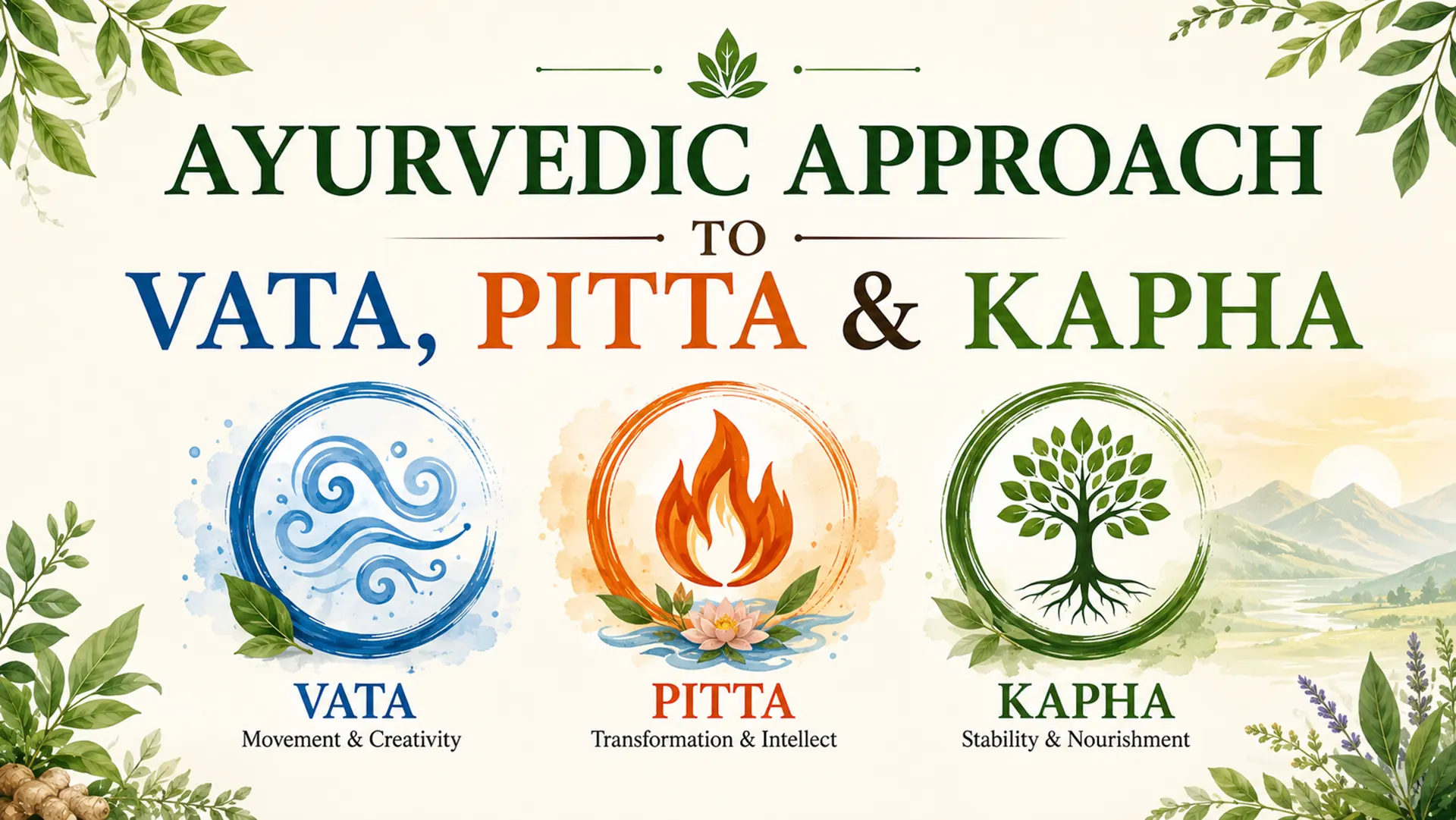
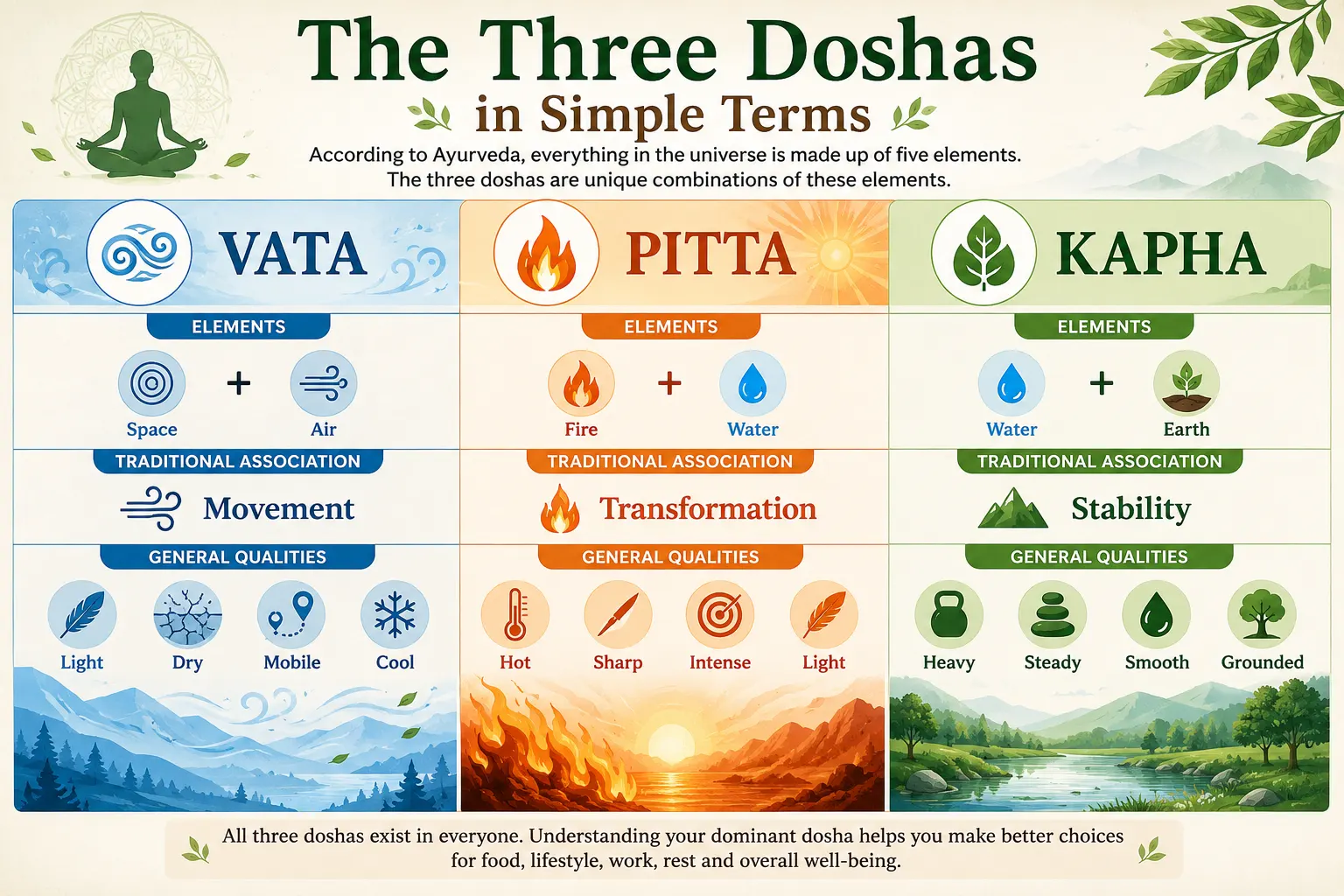
Ayurveda describes Vata, Pitta and Kapha as the three doshas, traditionally derived from combinations of the five great elements. Vata is associated with space and air, Pitta with fire and water, and Kapha with water and earth. Within the Ayurvedic framework, Vata is associated with movement, Pitta with transformation, and Kapha with stability and structure. Ministry of AYUSH – Ayurveda: The Science and Art of Life
The three doshas are traditionally considered present in everyone, but their proportions differ. Some people may have predominantly Vata, Pitta or Kapha characteristics, while others may have combinations such as Vata-Pitta, Pitta-Kapha or Vata-Kapha. Ministry of AYUSH educational material describes seven broad Prakriti types, including the three single-dosha types, three dual-dosha types and a Tridosha constitution. AYUSH Next – Prakriti and Dosha Body Types
The Three Doshas in Simple Terms
| Dosha | Elements | Traditional Association | General Qualities |
|---|---|---|---|
| Vata | Space + Air | Movement | Light, dry, mobile, cool |
| Pitta | Fire + Water | Transformation | Hot, sharp, intense, light |
| Kapha | Water + Earth | Stability | Heavy, steady, smooth, grounded |
Ayurvedic Approach to Vata
Vata is traditionally associated with space and air and is considered the principle of movement. Ayurvedic descriptions associate Vata with activities involving movement, communication and transportation within the body. Vata is also traditionally described through qualities such as lightness, dryness, coolness and mobility. CCRAS – Ayurveda: The Science of Life Dossier
People with predominantly Vata characteristics are traditionally described as active, creative, adaptable and enthusiastic. Ministry of AYUSH’s Prakriti material describes Vata-type individuals as generally having a thinner body frame, variable appetite and lighter sleep, although individual characteristics can vary considerably. AYUSH Next – Vata Prakriti Characteristics
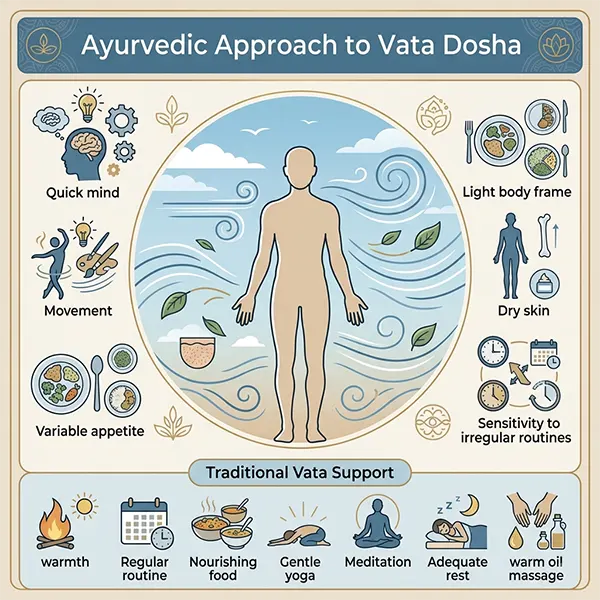
Vata Characteristics
A Vata-predominant constitution may traditionally be associated with:
- Lean or slender body structure
- Variable appetite
- Dry skin
- Light sleep
- High activity levels
- Quick learning
- Creative thinking
- Greater sensitivity to changes in routine
These are traditional constitutional descriptions rather than diagnostic criteria. A person’s actual constitution should be assessed by considering the overall pattern rather than one physical feature. AYUSH Next – Prakriti Analysis
Ayurvedic Lifestyle Approach for Vata
The traditional approach to Vata generally emphasizes qualities that provide warmth, nourishment, stability and regularity. Maintaining consistent meal and sleep times, choosing warm freshly prepared foods, practicing gentle movement and creating a calming daily routine are commonly incorporated into traditional Ayurvedic approaches. Ministry of AYUSH – Ayurveda and Daily/Seasonal Regimens
For Vata-oriented wellness, traditional self-care may also include Abhyanga, or oil massage. Sesame oil is traditionally associated with Vata-oriented routines because of its warming and nourishing qualities. Therapeutic Ayurvedic procedures, however, should ideally be selected according to individual needs and performed or recommended by an appropriately trained practitioner. WHO – Benchmarks for the Practice of Ayurveda
Herbal Support Traditionally Associated With Vata
Ayurvedic traditions commonly use warming culinary ingredients such as ginger, cinnamon and cardamom in routines intended to support Vata-oriented qualities. Ginger in particular is widely used as a culinary spice and has a long history of use in traditional medicine. However, using an herb as food is different from taking a concentrated extract or supplement, and the latter may not be suitable for everyone. NCCIH – Ayurvedic Medicine: In Depth
A practical Vata-supportive approach can therefore focus first on warm meals, regular routines, adequate rest and calming activities, with herbs used appropriately rather than treating a single herb as a universal solution.
Ayurvedic Approach to Pitta
Pitta is traditionally associated with fire and water and represents transformation. In Ayurvedic philosophy, Pitta is associated with digestion, metabolism, transformation and body temperature. It is traditionally described through qualities including heat, sharpness, intensity and lightness. CCRAS – Ayurveda: The Science of Life Dossier
Pitta-dominant individuals are traditionally described as having a medium body frame, strong appetite, practical thinking and good capacity for vigorous activity. They may also be described as focused, decisive, organised and goal-oriented. AYUSH Next – Pitta Prakriti Characteristics
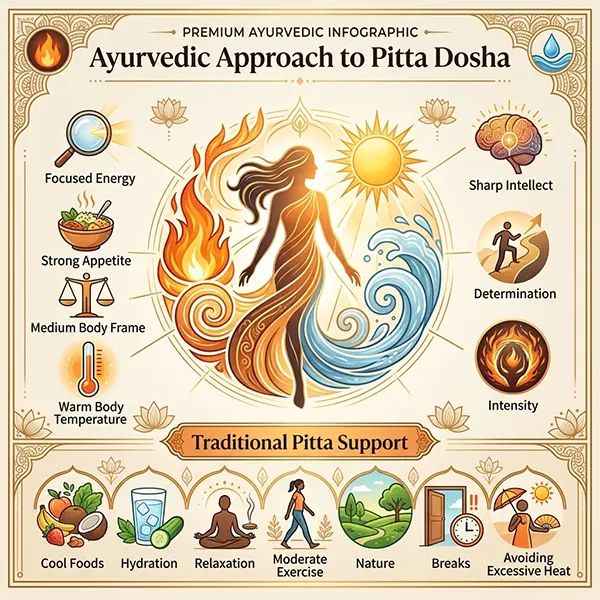
Pitta Characteristics
Traditional Pitta characteristics may include:
- Medium or well-proportioned body frame
- Strong appetite
- Warm body temperature
- Sensitive skin
- Focused thinking
- Strong determination
- Good organisational ability
- Intense work habits
These characteristics describe traditional Ayurvedic patterns and should not be interpreted as medical or psychological diagnoses. AYUSH Next – Prakriti Body Types
Ayurvedic Lifestyle Approach for Pitta
Because Pitta is traditionally associated with heat and intensity, Ayurvedic lifestyle approaches generally emphasize moderation, cooling influences, relaxation and avoiding excessive heat. Adequate hydration, regular breaks, moderate physical activity and time spent relaxing can be incorporated into a Pitta-oriented lifestyle. Ministry of AYUSH – Ayurveda and Lifestyle Principles
Pitta-oriented individuals may particularly benefit from balancing periods of intense work with sufficient recovery. The Ayurvedic principle is not to suppress ambition or productivity but to avoid excessive intensity and maintain balance.
Herbal Support Traditionally Associated With Pitta
Traditional Ayurvedic approaches may incorporate culinary herbs and ingredients such as coriander, fennel and mint when a cooling-oriented routine is desired. Amla, or Indian gooseberry, is another well-known Ayurvedic ingredient used in traditional formulations. However, the effects and safety of concentrated herbal products can differ from those of herbs consumed as ordinary foods or spices. NCCIH – Ayurvedic Medicine and Safety
Therefore, Pitta-oriented herbal support is best considered alongside diet, hydration, rest and appropriate lifestyle practices rather than as a standalone treatment.
Ayurvedic Approach to Kapha
Kapha is traditionally associated with water and earth and represents stability, structure, nourishment and groundedness. Ayurvedic descriptions associate Kapha with physical strength, stability, lubrication and structural support. CCRAS – Ayurveda: The Science of Life Dossier
Kapha-predominant individuals are traditionally described as having a medium-to-broad or sturdy body frame, smooth skin, stable energy and a calm temperament. They may take longer to adapt to change but can be persistent and steady once they establish a routine. AYUSH Next – Kapha Prakriti Characteristics
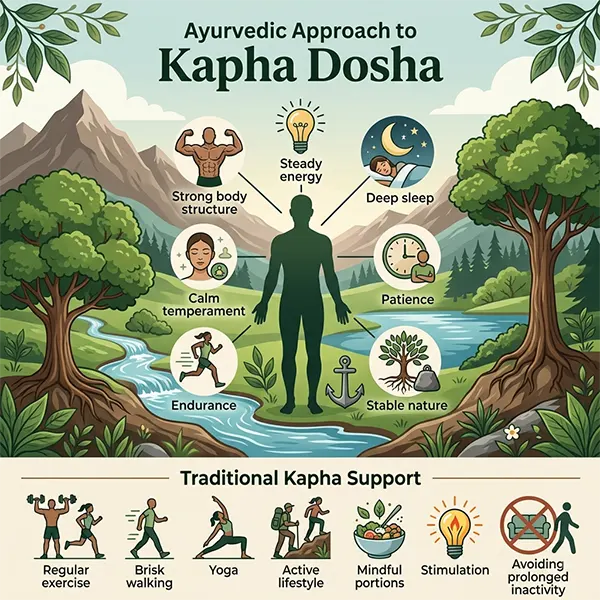
Kapha Characteristics
Traditional Kapha characteristics may include:
- Strong or sturdy body structure
- Stable energy
- Smooth or thicker skin
- Deep sleep
- Calm temperament
- Patience
- Endurance
- Steady nature
Again, these are traditional constitutional descriptions and should not be treated as medical diagnostic criteria. AYUSH Next – Prakriti Analysis
Ayurvedic Lifestyle Approach for Kapha
Because Kapha is traditionally associated with heaviness, stability and slowness, Ayurvedic approaches commonly emphasize movement, activity and stimulation. Regular exercise, brisk walking, yoga and avoiding prolonged inactivity can form part of a Kapha-supportive routine. Ministry of AYUSH – Ayurveda: The Science of Life
Kapha-oriented dietary approaches traditionally emphasize appropriate portions and lighter food choices according to the individual’s needs. However, restrictive diets should not be adopted solely because someone identifies as Kapha. Nutritional requirements depend on many individual factors.
Herbal Support Traditionally Associated With Kapha
Traditional Ayurvedic practices commonly use warming culinary herbs and spices such as ginger, turmeric, black pepper and cinnamon. These ingredients can easily be incorporated into ordinary meals, but concentrated extracts or multi-herb supplements should be approached more carefully because their dose and physiological effects can differ substantially from culinary use. NCCIH – Ayurvedic Medicine: In Depth
For Kapha-oriented wellbeing, herbs are best considered one part of a broader routine that includes physical activity, balanced nutrition, adequate sleep and an active lifestyle.
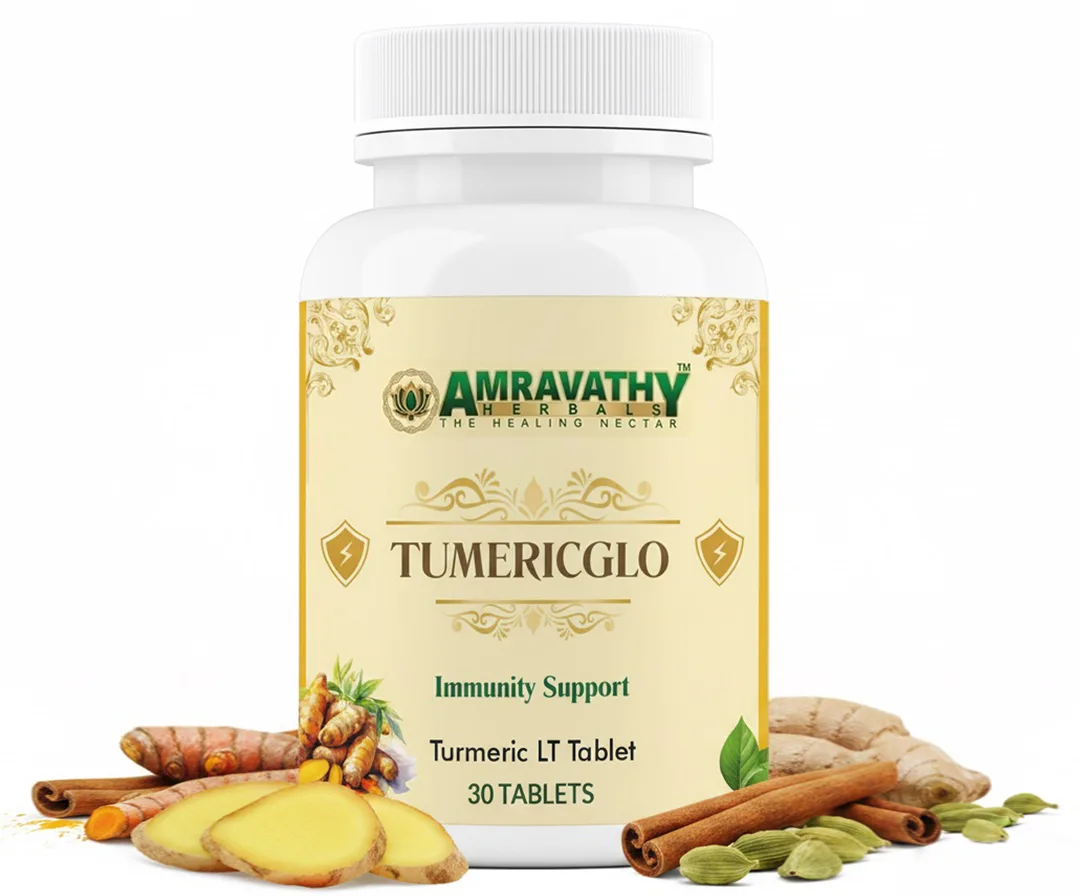
Tumericglo Turmeric Immunity Tablet (30 Tablets)
Can One Person Have More Than One Dosha?
Yes. Ayurveda recognizes that individuals may have combinations of doshas. The traditional framework includes Vata-Pitta, Vata-Kapha and Pitta-Kapha constitutions in addition to predominantly Vata, Pitta or Kapha constitutions and a relatively balanced Tridosha constitution. AYUSH Next – Seven Prakriti Types
For example, a Vata-Pitta person may traditionally display Vata’s adaptability alongside Pitta’s focus. A Pitta-Kapha person may combine Pitta’s intensity with Kapha’s stability, while a Vata-Kapha individual may combine creativity with groundedness. These combinations demonstrate why an individual should not be classified solely on the basis of body weight, skin type or one personality trait.
Prakriti vs. Current Dosha State
Prakriti refers to an individual’s natural constitution in Ayurvedic thought. The Ministry of AYUSH describes Prakriti as being established around conception and as representing an individual’s constitutional pattern, with some people being predominantly Vata, Pitta or Kapha and others having combinations. Ministry of AYUSH – Overview of Prakritis of Ayurveda
Your current condition may not always reflect your natural constitution. Ayurveda therefore distinguishes the person’s underlying constitution from changes that may occur due to diet, lifestyle, environment, seasons and other factors. Modern reviews have noted that although Prakriti assessment is an important area of Ayurvedic research, assessment tools vary and require further scientific validation and standardisation. Critical Review of Prakriti Assessment Tools – PMC
Herbal Approach to Dosha Balance
Ayurvedic herbal practice is traditionally individualized. Rather than selecting an herb simply because someone identifies as Vata, Pitta or Kapha, traditional Ayurvedic assessment considers the person’s constitution, current condition, digestion, environment, age, season and other factors. This individualized approach is one reason why self-prescribing complex herbal formulations may not always be appropriate. CCRAS – Ayur Prakriti Web Portal
For everyday wellness, culinary herbs and spices such as ginger, turmeric, coriander, fennel, cinnamon and mint can be incorporated into meals according to personal dietary preferences. This is different from using concentrated extracts, capsules or multi-herbal medicinal formulations, which may have different doses, effects and safety considerations. NCCIH – Ayurvedic Medicine: In Depth
It is therefore more accurate to describe herbs as traditionally used to support dosha balance rather than saying that herbs “cure” Vata, Pitta or Kapha imbalance. Evidence for Ayurvedic medicine varies considerably by condition and formulation, and relatively few high-quality clinical trials have evaluated Ayurveda as a whole. NCCIH – Ayurvedic Medicine: In Depth
Ayurveda, Herbs and Modern Healthcare
Ayurvedic practices should not be used to delay appropriate medical diagnosis or treatment. NCCIH advises people with health conditions to discuss Ayurvedic products with their healthcare providers and notes that some Ayurvedic preparations may contain potentially toxic levels of heavy metals such as lead, mercury or arsenic. NCCIH – Ayurvedic Medicine: In Depth
Quality and safety are particularly important when choosing herbal or Ayurvedic products. WHO’s benchmarks for Ayurveda address practitioner qualifications, safety, quality assurance, health products and regulatory considerations, while WHO’s broader traditional-medicine guidance emphasizes practitioner competence, product quality, appropriate regulation and safety monitoring. WHO – Benchmarks for the Practice of Ayurveda WHO – Traditional Medicine: Safety and Quality
How to Choose an Ayurvedic Herbal Product Responsibly
When choosing an Ayurvedic or herbal product, consumers should look for clearly identified ingredients, manufacturer information, appropriate labeling, batch details and evidence of quality testing where available. Be cautious about products that promise to cure multiple unrelated diseases or guarantee instant results. Quality control is particularly important because herbal products can vary in composition and concentration. WHO – Traditional Medicine: Quality and Safety
Special care is warranted with concentrated formulations, particularly for pregnant or breastfeeding individuals, children, older adults taking multiple medicines and people with chronic health conditions. Herbal products can interact with medicines, and “natural” does not automatically mean risk-free. NCCIH – Ayurvedic Medicine: In Depth
A Simple Ayurvedic Approach for Vata, Pitta and Kapha
For Vata, the traditional focus is warmth, grounding, nourishment, regularity and calmness. For Pitta, the emphasis is cooling, moderation, hydration and relaxation. For Kapha, the focus is movement, stimulation, activity and lightness. These principles are based on the traditional Ayurvedic idea of balancing qualities through appropriate diet, lifestyle and individualized practices. CCRAS – Ayurveda: The Science of Life Dossier
Herbs can complement these traditional approaches, but they should not be treated as the entire solution. A healthy lifestyle that includes nutritious food, appropriate physical activity, sufficient sleep, stress management and professional healthcare when necessary provides a broader foundation for wellbeing. WHO emphasizes that traditional medicine should be supported by appropriate standards for quality, safety, training and regulation. WHO – Benchmarks for the Practice of Ayurveda
Conclusion
Vata, Pitta and Kapha are among Ayurveda’s most important traditional concepts for understanding individual constitution. Vata is associated with movement, Pitta with transformation, and Kapha with stability. Everyone is traditionally understood to possess all three doshas, although their proportions can differ from person to person. Ministry of AYUSH – Ayurveda: The Science and Art of Life
Understanding your traditional constitution can encourage greater awareness of your food choices, daily routine, activity, sleep and responses to environmental changes. However, an online dosha quiz or a single characteristic cannot provide a complete health assessment. Research into Prakriti assessment continues to examine how these traditional constitutional concepts can be measured more consistently and scientifically. Critical Review of Prakriti Assessment Tools – PMC
The Ayurvedic approach is ultimately about individualisation and balance. Vata may traditionally benefit from grounding routines, Pitta from moderation and cooling practices, and Kapha from movement and stimulation. Herbs may be incorporated as part of these traditional approaches, but responsible use requires attention to individual circumstances, product quality, dosage and potential interactions. NCCIH – Ayurvedic Medicine: In Depth
Your body is unique. Your constitution is unique. Your wellness routine can be unique too.
The most practical approach is to combine traditional Ayurvedic wisdom with nutritious food, regular movement, adequate sleep, stress management and evidence-based healthcare. Ayurveda can provide a traditional framework for understanding individual tendencies, while qualified healthcare professionals can help identify and manage medical conditions when they arise. WHO – Traditional Medicine
Disclaimer
This article is for educational and general wellness purposes only. Vata, Pitta, Kapha and Prakriti are traditional Ayurvedic concepts and should not be considered medical diagnoses. Herbal products should not be used to replace prescribed medical treatment. If you have a medical condition, take medication, are pregnant or breastfeeding, or have persistent or concerning symptoms, consult a qualified healthcare professional before using Ayurvedic medicines or concentrated herbal supplements.